Showing posts with label Japan. Show all posts

The Well-Known Japanese Food “Sushi”

November 9, 2011 1 comments
The Beginnings of Sushi

Sushi has been around for a surprisingly long period of time, although not in its present form. The history of sushi is an interesting tale of the evolution of a simple dish. What was to become sushi was first mentioned in China in the second century A.D. Originally, sushi arose out of a way of preserving food. Fish was placed in rice and allowed to ferment, which allowed an individual to keep the fish edible for some time. The rice was thrown away and the fish was eaten when needed or wanted.

The method spread throughout China and by the seventh century, had made its way to Japan, where seafood has historically been a staple. The Japanese, however, took the concept further and began to eat the rice with the fish. Originally, the dish was prepared in much the same manner. In the early 17th century, however, Matsumoto Yoshiichi of Edo (now Tokyo) starting seasoning the rice with rice wine vinegar while making his ‘sushi’ for sale. This allowed the dish to be eaten immediately, instead of waiting the months it might normally take to prepare the ‘sushi.’

Well-known 'Sushi'

The Evolution of Sushi

In the early 19th century, a man by the name of Hanaya Yohei conceived a major change in the production and presentation of his sushi. No longer wrapping the fish in rice, he placed a piece of fresh fish on top of an oblong shaped piece of seasoned rice. Today, we call this style ‘nigiri sushi’ (finger sushi) or “edomae sushi” (from Edo, the name of Tokyo at the time) and is now the common way of eating Japanese sushi. At that time, sushi was served from sushi stalls on the street and was meant to be a snack or quick bite to eat on the go. Served from his stall, this was not only the first of the real ‘fast food’ sushi, but quickly became wildly popular. From his home in Edo, this style of serving sushi rapidly spread throughout Japan, aided by the Great Kanto earthquake in 1923, as many people lost their homes and businesses and moved from Tokyo.

After World War Two, the sushi stalls were shut down and moved indoors, to more sanitary conditions. More formal seating was later provided (the first iterations were merely an indoor version of the sushi stalls) and sushi changed from ‘fast food’ to a true dining experience. Sushi spread around the globe, and with the advent of the promotion of seafood, this unusual style of serving fish was quickly adopted by western cultures, always eager for something new, especially something that had grown as sophisticated and unique as sushi.

Modern Sushi

Sushi, the artful dining experience once uniquely Japanese, has now evolved to another level beyond the traditional Japanese methods. Western influences have given rise to new styles of sushi, such as California rolls and the many elaborate ‘fusion’ creations at upscale sushi restaurants. The history of sushi is a long one, at least 1,800 years in fact, but the current iteration is popular around the world, and rightly so. It is not often that something so singly cultural can not only take the world by storm, but also influence the direction of food in other cultures. Demand for sushi is only increasing and seems to be continuing to evolve. Traditional sushi restaurants sit alongside ‘fusion’ restaurants and both are popular for their own reasons. The history of sushi is still far from over.
[Read More...]

Mt. Fuji

August 23, 2010 Leave a comment
Mt. Fuji Japan

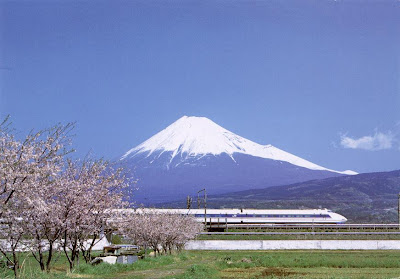
Mount Fuji is the highest mountain in Japan at 3,776 m (12,388 ft).An active volcano that last erupted in 1707–08, it straddles the boundary of Shizuoka and Yamanashi prefectures just west of Tokyo, from which it can be seen on a clear day. It is located near the Pacific coast of central Honshū. Three small cities surround it: Gotemba (east), Fujiyoshida (north) and Fujinomiya (southwest).

Mount Fuji’s exceptionally symmetrical cone is a well-known symbol of Japan and it is frequently depicted in art and photographs, as well as visited by sightseers and climbers.

Mt. Fuji Summit
[Read More...]

Going to Mt. Fuji

August 4, 2009 Leave a comment

Mount Fuji (富士山 Fuji-san, 3776 meters) is Japan's highest mountain and the focal point of the sprawling Fuji-Hakone-Izu National Park. Visible from Tokyo on a clear day, the mountain is located to the west of Tokyo on the main island Honshu.

A perfectly symmetrical volcanic cone, the mountain is a near-mythical national symbol immortalized in countless works of art, including Hokusai's 36 Views of Mt. Fuji.

The Japanese always refer to Mt. Fuji as Fuji-san, but the -san (山) here simply means "mountain", and has nothing to do with the honorific san (さん) for people's names. "Fujiyama" is a misreading of the name, and is never used by the Japanese themselves — except in the set phrase Fujiyama geisha, a lament at how Japan is misunderstood in the West.

The official climbing season lasts for only two months, from July to August. Even during these months, when Tokyo often swelters in 40°C heat, temperatures at the top can be below freezing at night and climbers must dress adequately.

Climbing outside the official season is extremely dangerous without alpine climbing experience and equipment. Nearly all facilities are closed in the off season. The weather, unpredictable any time of year, is downright vicious in the winter (temperatures below -40°C have been reported up top) and there are cases of people being literally blown off the mountain by high winds. All roads to the 5th station are shut out of season so you will have a long walk up. But if you insist, you're strongly encouraged to at least file a climbing plan with the Yoshida police (Japanese only).

Mount Fuji

Fortunately, there are a few options for those who are not fit enough to climb or who would like to get "up close" to the mountain in the off-season. The trails at the bottom of the mountain are less steep, and suited more for an afternoon hike at any time of the year. The nearby Fuji Five Lakes (Fuji-goko) has many attractions close to the mountain, and Hakone also provides spectacular views.

Mt. Fuji can be approached from all sides, but note that transport schedules are sharply cut outside the official climbing season in July and August. For up to date information, the city of Fujiyoshida maintains a Fuji access page listing current routes and schedules.

From Tokyo, the easiest and most popular option is to take a direct bus from Shinjuku to the trailhead at Kawaguchiko Fifth Station. The most economical approach is by Odakyu train from Shinjuku to Gotemba, although you will have to change trains and the price difference is rather minimal.

Mt. Fuji Shizuoka Airport near Shizuoka opened in June 2009. Despite the name, it's over 80 km away to the west of the mountain and not much closer to Mt. Fuji than Tokyo's airports.

Mount Fuji Map

The easiest option for reaching the slopes of Mt. Fuji is to take the Keio express bus from Shinjuku in Tokyo. The direct bus takes 2 to 2.5 hours, depending on traffic, costs ¥2600, and takes you directly to the start of the climb at Kawaguchiko 5th Station. To buy a ticket, take the west exit at Shinjuku station, then follow the circle of bus stops to the left. The Keio building is on the corner near stop 26, right across from Yodobashi Camera.

There is no direct access to Mt. Fuji by train, but you can get pretty close and change to a bus for the rest of the way, and doing it this way allows you to use any of the ascent or descent routes. From Tokyo, the two main staging points are Fujiyoshida and Gotemba, while visitors from western Japan can opt for Fujinomiya (Shin-Fuji) instead.

Fujiyoshida can be reached by taking the JR Chuo line to Otsuki and changing to the Fujikyu line. The Fujikyu line passes through Fujiyoshida to Kawaguchiko, from where hourly buses (50 minutes, ¥1700) shuttle to the 5th Station. If you are planning to walk from the foot of the mountain, Fujiyoshida is, also, the starting point of the Yoshida route. You will be able to visit Fujiyoshida Sengenjinja (shrine) on the way to the summit.

If heading for the Gotemba route (御殿場), Subashiri route, or Suyama route, take the JR Tokaido line from Tokyo through Odawara to Kōzu (府津) station then change train for Gotemba. Alternatively, if traveling from Shinjuku, take the Odakyu line to Shin-Matsuda and walk to the neighboring Gotemba line Matsuda station. This local train usually runs just once per hour.

Going to Mt. Fuji

During official climbing season there are direct buses from the Gotemba station to the Gotemba 5th station that take about 40 minutes and cost ¥1080/1500 one-way/return. Tickets to the Subashiri 5th station are ¥1500/2000 one-way/return. A bus for the Suyama route is ¥530 one-way. If you want to ascend and descend on different routes, you can purchase a 3-day round trip ticket for a little over ¥3000. Note that Gotemba buses run only during the official Fujisan mountain climbing season between July and August, but Subashiri route busses run till October and Suyama route busses run all year around.

There is also a bus to Kawaguchiko from the Gotemba station and a bus from Shin-Matsuda to the Kawaguchiko fifth station (¥3000 one-way).

Visitors coming from western Japan may wish to opt for the southern approach via Fujinomiya (富士宮) instead. The nearest Tokaido Shinkansen stop is Shin-Fuji station (新富士駅). From Shin-Fuji station, buses cost ¥4500 return. If arriving on the ordinary Tokaido line, change trains to the JR Minobu Line at Fuji station. The bus fare from Fujinomiya station to the 5th station of Mt. Fuji is 1,970 for one-way or 3,000 for round-trip.

By car take the Chuo Expressway from Shinjuku. Tolls will set you back around ¥2500.

There are also Fuji-san climbing tours offered by numerous travel companies throughout Japan. These tours may include round trip bus fare, climbing guide, hut, dinner, breakfast (packed rice box), and a visit to a hot spring after the descent. Prices tend to be expensive though: a one-day "superman" tour costs around ¥20000 and a more leisurely two-day approach (including overnight stay) is over ¥30000. Most of these tours are conducted in Japanese and stick firmly to the trodden path, but if you need an English-speaking guide to accompany you to the top or want to explore the less-well known "pilgrimage" routes, Fuji Mountain Guides offers small group ascents from US$249 for a two-day trip, including lodging.

Source: WikiTravel

[Read More...]